

The Bank of England’s Monetary Policy Committee voted unanimously to keep Bank Rate on hold at 3.75% at its March 2026 meeting, as a sharp spike in global energy prices triggered by conflict in the Middle East forced policymakers to shift their focus back to inflation risks.
Markets had been pricing in a 7-2 vote in favor of keeping rates unchanged, as several members noted that they would have supported a 25 basis point cut at this meeting had the US-Iran war not happened.
Key Takeaways
- Unanimous hold at 3.75%. All nine MPC members voted to maintain Bank Rate, pausing what had been a gradual easing cycle that began in 2024.
- Energy prices are the dominant risk. Brent crude has risen to over $100 per barrel while European wholesale gas prices have climbed a similar amount.
- Near-term inflation projections revised sharply higher. CPI inflation, which had fallen to 3.0% in January, is now expected to be close to 3.5% in March.
- Second-round effects are the key watch item. The MPC stressed that its primary concern is not the direct energy price pass-through, which monetary policy cannot offset, but the risk that higher energy costs embed themselves in wage and price-setting behavior.
- Growth risks acknowledged but secondary. The committee noted that higher energy costs will squeeze real incomes and may weigh on consumer confidence and business investment.
- The door to both cuts and hikes remains open. Members explicitly noted that future policy could move in either direction depending on how the conflict evolves.
The committee projects that inflation could reach up to 3.5% again in Q3 2026, primarily through higher fuel and utility prices. This compares with the February Report forecast of a return toward the 2% target by Q2.
Link to official BOE Monetary Policy Statement & MPC Minutes (March 2026)
Furthermore, policymakers noted that the economy was already operating with a degree of spare capacity coming into the energy shock, with Q4 2025 GDP growth of just 0.1% and unemployment at 5.2%. A short-lived disruption could see rate cuts resume while a prolonged shock that drives persistent second-round inflation effects could warrant a hold or even a hike.
Market Reaction
British Pound vs. Major Currencies: 5-min
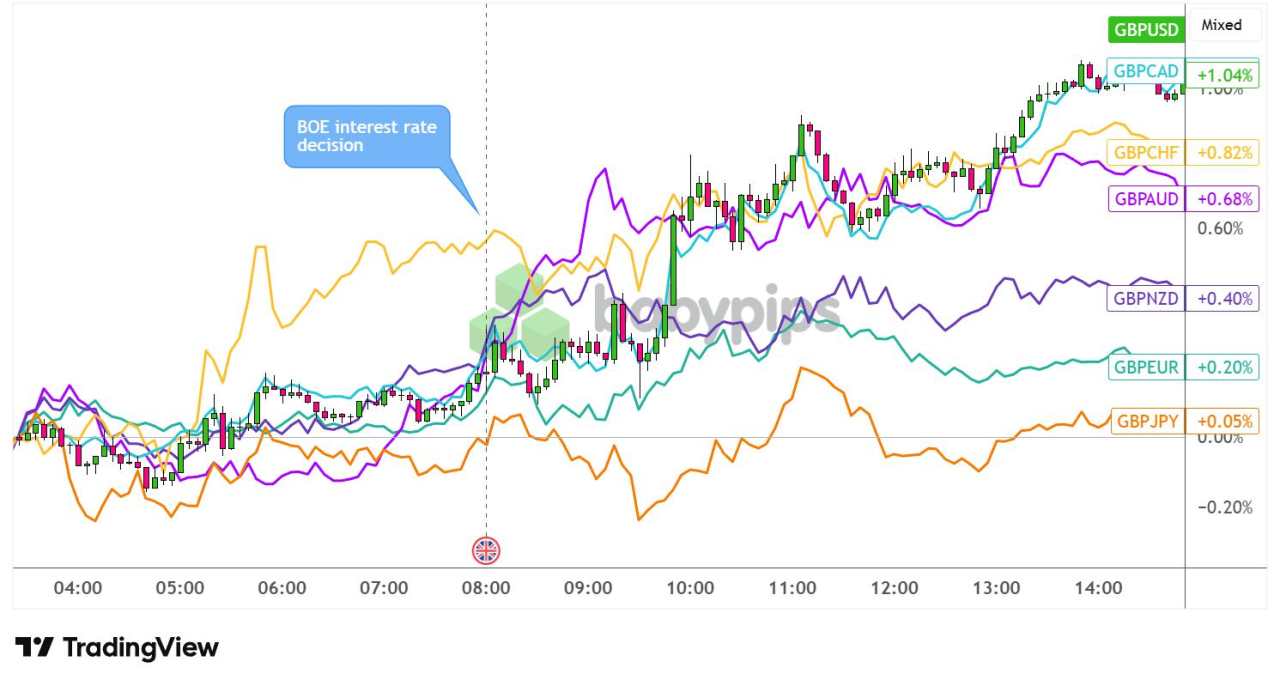
Overlay of GBP vs. Major Currencies – Chart Faster with TradingView
However, the reaction was still pretty mixed, as gains against EUR (+0.20%), JPY (+0.05%) and CHF (+0.82%) were faded within an hour after the decision. GBP managed to sustain its initial bullish reaction against NZD (+0.40%), AUD (+0.68%), CAD (+1.33%) and USD (+1.04%) until the start of the next trading session.
Though market participants acknowledged the hawkish pivot of the BOE, doubts lingered about potential tightening repercussions on already sluggish U.K. growth that could force a return to easing much later down the road.
Promoted: Capitalize on BOE Volatility Without Risking Your Own Funds.
The BOE hawkish hold provided some support for sterling, though concerns about tightening remained. When the macroeconomic data shifts this fast, trading the volatility requires deep focus—and enough capital to make your edge count.
If you have the right fundamental bias but a restrictive personal account size, Funded Trading Plus can help. They offer evaluation packages starting at just $89.00. Prove your skills with simple, fair rules, and you can double your account every 10% up to $2,500,000.
Learn more about Funded Trading Plus! (for a limited time, use code “20CHAL” for 20% off on 1-Step & 2-Step Challenges, Up to $100k account size)
Disclosure: To help support our content, we may earn a commission from our partners if you sign up through our links, at no extra cost to you.

Leave Your Message Now