



In Forex, price does not move because an asset is labelled “safe” or “risky.” It moves because capital reallocates in response to changing expectations around growth, liquidity, and policy.
Understanding the relationship between safe haven assets and risk assets gives traders a decision making framework, not just a narrative. This distinction is what separates analysis from opinion.
1. Safe Haven Demand Is About Liquidity, Not Fear Alone
Safe havens are often misunderstood as assets that rise only during panic. In reality, they attract flows when capital prioritizes liquidity, stability, and optionality.
Key characteristics traders should monitor:
- Depth and liquidity: Markets where large positions can be entered or exited with minimal friction
- Policy credibility: Central banks perceived as predictable and disciplined
- Low counterparty risk: Jurisdictions with strong legal and financial infrastructure
Safe haven strength usually reflects risk reduction, not emotional fear. This is why safe havens can strengthen even during calm markets if positioning becomes crowded elsewhere.
2. Risk Assets Reflect Confidence in Forward Conditions
Risk assets perform well when markets believe:
- Growth will remain resilient
- Financial conditions will stay accommodative
- Policy tightening will be limited or delayed
In Forex terms, risk on behavior often appears through:
- Demand for higher yielding currencies
- Exposure to trade sensitive economies
- Capital inflows into equity linked FX
The critical point is timing. Risk assets typically price expectations, not current conditions. By the time economic data peaks, risk assets may already be vulnerable.
3. The Transition Phase Matters More Than the Extremes
Most losses occur not during full risk on or full risk off environments, but during transition phases.
Signs traders should watch closely:
- Rising volatility without a clear trend
- Divergence between equities and FX
- Safe havens strengthening selectively, not broadly
- Short lived rallies in risk assets that fail to hold
These conditions suggest uncertainty around policy direction or growth sustainability. Markets are recalibrating, not committing.
4. Interest Rate Expectations Are the Core Driver
Safe haven and risk asset flows ultimately trace back to relative interest rate expectations.
What matters is not whether rates are high or low, but:
- Which economy is expected to ease first
- Where real yields are improving or deteriorating
- How long current policy settings are expected to last
A risk asset can weaken even during strong growth if markets believe tighter policy will cap future returns. Conversely, a safe haven can strengthen even with modest data if rate expectations stabilize.
5. How Professional Traders Apply This in Practice
Rather than asking whether the market is “risk on or risk off,” experienced traders focus on:
- Relative positioning: Which trades are overcrowded
- Asymmetry: Where downside risk exceeds upside potential
- Policy sensitivity: Which assets react most to changes in rate expectations
This leads to more selective trades:
- Favoring relative value FX pairs
- Reducing exposure during unclear regimes
- Letting capital flow signals confirm the narrative
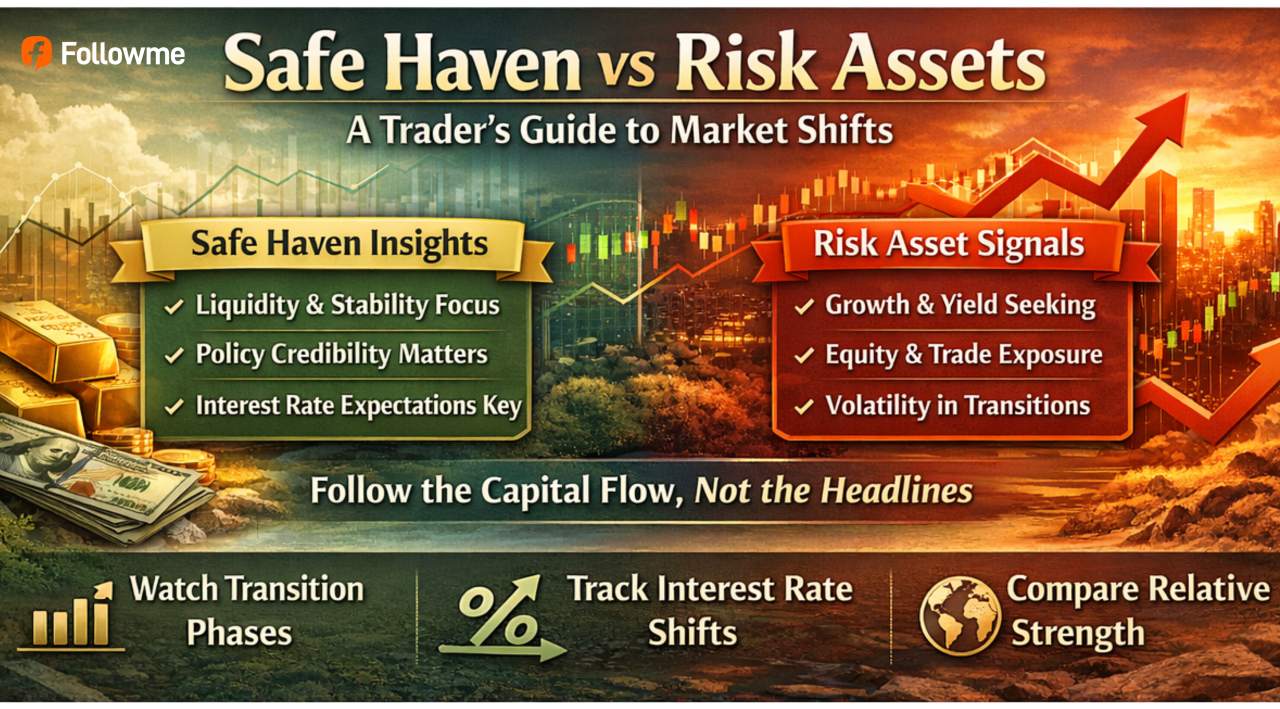
The Strategic Insight
Safe haven versus risk asset dynamics are not about predicting sentiment. They are about tracking how expectations shift and where capital seeks efficiency.
Markets do not move from optimism to fear overnight. They move through reallocation.
Traders who recognize that process early gain an edge not by forecasting headlines, but by understanding flow behavior beneath them.
In Forex, the question is never simply what is safe or what is risky. It is always: safe or risky compared to what, and under which conditions.
Disclaimer: The views expressed are solely those of the author and do not represent the official position of Followme. Followme does not take responsibility for the accuracy, completeness, or reliability of the information provided and is not liable for any actions taken based on the content, unless explicitly stated in writing.

-THE END-