


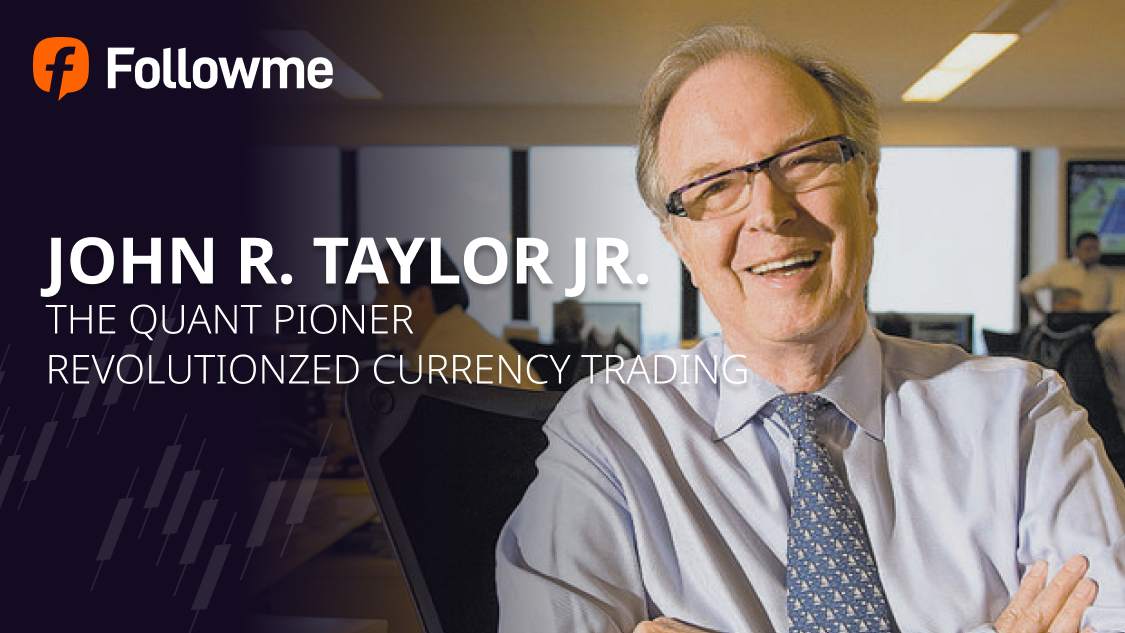
 When most traders were still relying on instinct and discretionary judgment, John R. Taylor Jr. was already building computer-driven models to understand the world’s currency markets. Long before “quant trading” became a dominant force on Wall Street, Taylor quietly pioneered its foundations beginning as early as 1981, when the word algorithmic was barely used outside computer science circles. Taylor’s brilliance was not in simply creating models, but in recognizing that currency markets followed identifiable patterns shaped by economic cycles, policy decisions, and human behavior. He believed the world was full of signals long before the industry knew how to measure them. This mindset led him to build one of the most influential currency trading firms in history: FX Concepts.
A New Way of Seeing the Currency Market
John R. Taylor Jr. began his career as an analyst with a deep focus on global macroeconomics. While many traders watched charts, Taylor watched the world interest rate cycles, central bank actions, political shifts, capital flows, long-term volatility regimes. But his strength came from fusing this macro understanding into computable logic. By the early 1980s, he started constructing models that attempted to quantify the rhythm of the currency market. His systems blended three layers of insight: fundamental macroeconomic indicators, behavioral tendencies of market participants, and technical price dynamics. These early models were built to predict turning points, detect trend quality, and capture the underlying pressure building inside currency pairs. It was a framework decades ahead of its time. When he launched FX Concepts in 1981, he did so with the conviction that currencies could be understood even predicted through disciplined, repeatable systems. The industry had never seen anything like it.
The Rise of FX Concepts
From its modest beginnings, FX Concepts grew steadily throughout the 1980s and 1990s, eventually becoming the world’s largest dedicated currency hedge fund. Corporations, pension funds, and institutions many unsure of how to manage currency risk during a rapidly globalizing world turned to Taylor’s firm for guidance. What set FX Concepts apart was not only the sophistication of its models, but the way Taylor integrated them. He did not believe in blindly following an algorithm. For him, models were instruments, not masters. He constantly refined them, adjusted parameters, and incorporated new information as the global landscape shifted. The system was alive, evolving with every cycle and every market regime. At its peak, FX Concepts managed over $14 billion in assets, a staggering figure for a currency-only fund. It dominated the space for decades, setting benchmarks for currency forecasting and risk management strategies adopted by banks and asset managers around the world.
Returns, Longevity, and the Challenge of an Evolving Market
While performance naturally fluctuated across different macro environments, FX Concepts was widely regarded as one of the most consistently disciplined firms in the history of the FX market. For many years, its flagship programs produced stable and attractive returns, particularly during periods of strong macro trends. The firm thrived in environments where currencies responded to clear economic differentials or global capital shifts conditions that allowed its models to identify and ride long-duration moves. Taylor ran FX Concepts for more than three decades. Few hedge funds in any asset class survive that long, and even fewer remain influential throughout their entire lifespan. Market structures evolved, central bank interventions increased, volatility regimes shifted dramatically, and the rise of high-frequency and machine-learning models changed the competitive landscape. But for most of its life, FX Concepts remained a reference point a pioneer that proved currencies could be traded scientifically. Even after the firm eventually closed in the early 2010s, largely due to abnormal market conditions and unprecedented monetary interventions that disrupted long-standing currency dynamics, Taylor’s methods continued shaping the industry. Many of today’s macro and systematic FX strategies carry traces of his original ideas.
The Legacy of a Market Architect
John R. Taylor Jr.’s contribution goes far beyond building one successful firm. He helped define what quantitative macro trading would become. He demonstrated that currencies are not random they are reflections of global relationships, policy cycles, and human psychology. And he showed that markets could be studied with academic discipline without losing the intuition that comes from experience. His work bridged two worlds: the structured logic of computation and the unpredictable nature of human behavior. In doing so, he became one of the foundational thinkers in the evolution of quantitative FX. Taylor may not have sought the spotlight, but his influence is unmistakable. The models, frameworks, and analytical philosophies he developed quietly reshaped how the world understands currency markets. And for traders today whether discretionary or systematic his legacy serves as a reminder that the pursuit of understanding is the true edge.
A Message to Followme Traders
To the Followme community:
Keep learning. Keep building. Keep refining your system.
Even John R. Taylor Jr. didn’t start as a master he built his expertise through decades of study, curiosity, and adaptation.
Your trading journey is the same:
- understand the world
- manage your risks
- stay disciplined
- and never stop improving
One day, it could be your strategy, your insights, or your experience that inspires thousands of traders around the world.
Disclaimer: The views expressed are solely those of the author and do not represent the official position of Followme. Followme does not take responsibility for the accuracy, completeness, or reliability of the information provided and is not liable for any actions taken based on the content, unless explicitly stated in writing.

Leave Your Message Now